
Nov 10, 2026

Businesses that transport perishable and temperature-sensitive products need to choose the right equipment to protect their cargo during transit. Fresh food, frozen products, pharmaceuticals, flowers, and other sensitive goods may require controlled temperature conditions throughout the shipping process.
Two common options are reefer containers and refrigerated trucks. Both are designed to maintain specific temperature conditions, but they serve different transportation needs.
Understanding the difference between a reefer container vs refrigerated truck can help businesses select suitable equipment, plan shipping routes, manage transportation costs, and reduce the risk of cargo damage.
Although both options provide temperature-controlled transportation, their design, transportation modes, capacity, and typical applications are different.
A reefer container is a refrigerated shipping container designed to transport temperature-sensitive cargo. It has an integrated refrigeration system that helps maintain the required temperature inside the container during transportation.
Reefer containers are commonly used for international shipping, particularly when cargo moves by ocean freight. They can also be transported by road and rail as part of an intermodal shipping arrangement.
These containers are designed to support the movement of perishable products over long distances. They are commonly used for:
Fresh fruits and vegetables
Frozen meat and seafood
Dairy products
Frozen food
Pharmaceuticals requiring controlled conditions
Flowers and other temperature-sensitive products
Reefer containers are available in different sizes and configurations. Common shipping container formats include 20-foot and 40-foot units, although availability and specifications depend on the carrier and equipment provider.
A reefer container uses a refrigeration unit to maintain the temperature conditions specified for the cargo.
The container is connected to an appropriate power supply while operating at terminals, on suitable vessels, or at other facilities. During transportation, the refrigeration system receives power through the relevant equipment arrangement.
The process generally involves:
Preparing the cargo according to its temperature and handling requirements.
Inspecting the container and refrigeration equipment.
Setting the required temperature conditions.
Loading and securing the cargo properly.
Connecting the container to the appropriate power source during transportation.
Monitoring conditions throughout the shipping journey.
Proper airflow is important because the refrigeration system needs sufficient space for air circulation. Cargo should be loaded according to the container's operating and loading guidelines.
A reefer container is generally intended to maintain suitable conditions for properly prepared cargo. It should not automatically be treated as a substitute for pre-cooling products before loading.
A refrigerated truck is a road vehicle equipped with an insulated cargo compartment and a refrigeration system. It is commonly used to transport temperature-sensitive products between warehouses, distribution centers, manufacturers, retailers, and other delivery locations.
Refrigerated trucks are also known as reefer trucks. They are widely used for domestic and regional transportation where businesses need temperature-controlled road freight.
These vehicles can transport different types of cargo, including:
Fresh fruits and vegetables
Meat and poultry
Seafood
Dairy products
Frozen food
Bakery products
Certain pharmaceutical products
The appropriate truck and temperature settings depend on the cargo, shipment size, route, and handling requirements.
A refrigerated truck uses an insulated cargo area and a refrigeration unit to help maintain the required temperature during road transportation.
The refrigeration system operates while the vehicle travels between pickup and delivery locations, following the equipment's operating requirements.
A typical refrigerated truck shipping process includes:
Checking the refrigeration unit and cargo compartment.
Confirming that the vehicle is clean and suitable for the shipment.
Preparing the cargo at the required temperature.
Setting the refrigeration system according to product instructions.
Loading the products while maintaining suitable airflow.
Transporting the shipment to its destination.
Unloading the cargo while following appropriate handling procedures.
Refrigerated trucks are useful when shipments need direct road transportation, scheduled deliveries, or distribution across multiple locations.
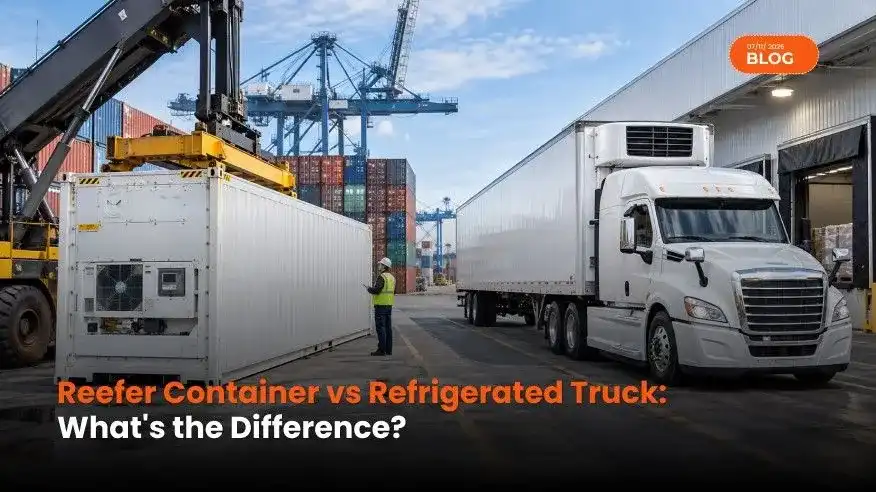
The main difference is that a reefer container is a temperature-controlled shipping unit, while a refrigerated truck is a complete road transportation vehicle.
Both can maintain controlled conditions, but their applications differ.
A reefer container is primarily associated with ocean freight and intermodal transportation. It can move between ships, ports, rail networks, and road transport as part of a larger logistics process.
A refrigerated truck is designed specifically for road transportation. It moves cargo between locations using highways and local road networks.
Which is better?
For international shipments involving ocean transportation, a reefer container may be suitable. For domestic deliveries and regional distribution, a refrigerated truck may be more practical.
Reefer containers are commonly used for long-distance international shipments. They allow businesses to move temperature-sensitive cargo across countries and between major shipping ports.
Refrigerated trucks are commonly used for local, regional, and long-distance domestic transportation. Their suitability depends on route conditions, delivery schedules, vehicle availability, and shipment requirements.
Neither option is limited to one specific distance. The best choice depends on the complete transportation route.
Reefer containers come in standardized shipping container formats, including common 20-foot and 40-foot configurations.
Refrigerated trucks are available in different vehicle sizes and cargo capacities. The available space depends on the truck type, body configuration, and applicable weight restrictions.
Businesses should compare usable cargo volume and payload limits rather than choosing equipment based only on its external dimensions.
Reefer containers are generally loaded at warehouses, distribution facilities, or other suitable locations. They are then moved through ports and transportation terminals as part of the shipping process.
Refrigerated trucks can be loaded and unloaded at warehouses, retail distribution centers, manufacturing facilities, and other delivery locations.
For businesses that need deliveries to multiple locations, refrigerated trucks may provide greater flexibility in arranging road-based distribution.
The cost of using a reefer container or refrigerated truck depends on several factors.
For reefer containers, costs may include:
Container transportation charges
Ocean freight rates
Port handling fees
Terminal-related charges
Power and monitoring arrangements
Customs and documentation costs
Inland transportation
Storage or detention-related charges, where applicable
For refrigerated trucks, costs may include:
Transportation distance
Fuel expenses
Refrigeration equipment operation
Shipment weight and dimensions
Vehicle type
Driver and operational costs
Pickup and delivery requirements
Waiting time and additional handling
There is no universal rule that one option is always cheaper. Businesses should compare complete shipment costs, including origin handling, transportation, destination handling, and any additional service requirements.
Both reefer containers and refrigerated trucks are designed to support temperature-controlled cargo transportation.
However, the equipment's operating conditions, monitoring arrangements, and temperature capabilities can vary.
A business should confirm:
Required temperature range
Chilled or frozen cargo requirements
Equipment suitability
Airflow and loading requirements
Monitoring and recording options
Procedures for handling temperature excursions
It is important to remember that the refrigeration system's air temperature reading may not represent the actual temperature of the product. Product-specific monitoring and assessment may be necessary.
Refrigerated trucks are often suitable for businesses that need flexible road deliveries. They can support transportation between suppliers, warehouses, stores, and distribution centers.
Reefer containers are useful when businesses need to move larger shipments through established ocean freight or intermodal networks.
For example, an importer receiving frozen food from another country may use a reefer container for the international shipping leg and a refrigerated truck to move the cargo from the port to a warehouse.
This combination can support an end-to-end cold chain transportation plan.
|
Comparison Factor |
Reefer Container |
Refrigerated Truck |
|
Main purpose |
Temperature-controlled shipping unit |
Temperature-controlled road vehicle |
|
Common transportation mode |
Ocean, rail, and road intermodal |
Road transportation |
|
Typical use |
International and long-distance cargo movement |
Domestic and regional distribution |
|
Equipment design |
Insulated shipping container with refrigeration unit |
Insulated vehicle compartment with refrigeration unit |
|
Common formats |
20-foot and 40-foot containers |
Different truck sizes and configurations |
|
Loading locations |
Warehouses, ports, and suitable terminals |
Warehouses, factories, distribution centers |
|
Distribution flexibility |
Depends on container movement and transfer arrangements |
Suitable for direct road deliveries |
|
Cost factors |
Ocean freight, terminal handling, container charges, inland transport |
Distance, fuel, vehicle, refrigeration, and delivery requirements |
|
Best suited for |
Suitable temperature-sensitive cargo moving through container networks |
Suitable temperature-sensitive cargo moving by road |
Reefer containers offer several advantages for businesses involved in international and large-scale freight transportation.
Reefer containers are designed to move through global shipping networks. Businesses can use them to transport suitable perishable cargo between international ports.
A reefer container can move between ocean vessels, rail, and road transportation without requiring the cargo to be unloaded at every transfer point.
This can help simplify cargo movement when the transportation plan is properly coordinated.
Common container sizes make it easier for businesses and logistics providers to plan cargo dimensions, loading arrangements, and transportation requirements.
Reefer containers can be suitable for substantial quantities of temperature-sensitive cargo, depending on product weight, packaging, and container capacity.
Refrigerated trucks are useful for businesses that need temperature-controlled road freight.
Businesses can arrange refrigerated truck transportation between manufacturing facilities, warehouses, retail locations, and distribution centers.
Refrigerated trucks can move cargo directly between suitable pickup and delivery locations without requiring ocean or rail transportation.
Depending on the vehicle and transportation arrangement, refrigerated trucks can support different delivery schedules and distribution requirements.
Food distributors, retailers, manufacturers, and suppliers often need refrigerated transportation between nearby cities and regional distribution hubs. Refrigerated trucks can support these movements.
A reefer container may be a suitable option when your business needs to transport temperature-sensitive cargo through an ocean freight or intermodal shipping network.
Consider a reefer container when:
Your shipment involves international transportation.
Cargo needs to move through ocean freight.
You are transporting suitable products in container-sized quantities.
The shipment requires coordinated port-to-port transportation.
Your logistics plan involves multiple transportation modes.
The destination can receive and handle refrigerated containers.
For example, a food exporter shipping frozen products from the United States to an overseas market may consider a reefer container for the international transportation leg.
The final decision should account for cargo specifications, transit time, port facilities, equipment availability, and destination handling arrangements.
A refrigerated truck may be more appropriate when cargo needs to move directly between domestic locations by road.
Consider refrigerated truck transportation when:
Your shipment is moving between cities within the country.
Your business needs warehouse-to-store deliveries.
You are distributing perishable products to regional customers.
The shipment requires road-based pickup and delivery.
You need a transportation arrangement suited to your shipment size and delivery schedule.
For example, a food distributor moving chilled dairy products from a processing facility to regional distribution centers may use refrigerated trucks for the road transportation.
Yes. Reefer containers and refrigerated trucks can work together as part of an integrated cold chain logistics process.
Many international shipments involve more than one transportation mode. A refrigerated container may carry products across the ocean, while a refrigerated truck handles inland transportation after the container reaches the destination port.
A typical transportation process may look like this:
Food products are prepared and packed at the origin facility.
The cargo is loaded into a suitable reefer container.
The container is transported to the departure port.
Ocean freight moves the container to the destination country.
The container is handled at the destination port.
Inland transportation is arranged using a suitable refrigerated truck or other appropriate equipment.
The shipment is delivered to the receiving warehouse or distribution center.
This approach allows businesses to combine international container shipping with domestic refrigerated transportation.
However, each transfer point needs proper coordination. Businesses should confirm that the equipment, power arrangements, handling procedures, and temperature-monitoring process are suitable throughout the journey.
Choosing between a reefer container and a refrigerated truck requires more than comparing equipment prices. Businesses should evaluate the complete shipment.
Consider these factors before making a decision:
Identify the product type, temperature range, packaging, loading requirements, and any special handling instructions.
Determine whether the shipment is domestic, international, or multimodal. The route will influence which equipment and transportation modes are practical.
Request quotes that clearly explain transportation, handling, equipment, and additional charges. Compare the full cost of moving the shipment rather than looking only at the main freight rate.
Confirm whether suitable equipment is available at the origin and destination. This is particularly important for specialized temperature-controlled shipments.
Review expected transit time, transfer points, delivery schedules, and possible delays. Perishable cargo may need additional planning to meet its handling requirements.
Ask how temperature conditions are monitored, how shipment updates are shared, and what procedures are followed if equipment or temperature issues occur.
Choosing the right transportation arrangement is an important part of managing a supply chain. Businesses shipping temperature-sensitive cargo need to consider equipment suitability, shipment size, transportation mode, route, and delivery requirements.
Empath Logistics provides freight and logistics solutions for businesses with different transportation needs. When planning refrigerated freight, businesses should share their cargo details, origin, destination, shipment volume, and handling requirements to help evaluate a suitable transportation arrangement.
For shipments involving international and domestic transportation, coordinating the different stages of the journey is particularly important.
The main difference between a reefer container and a refrigerated truck is their design and transportation application. A reefer container is a temperature-controlled shipping unit commonly used for ocean freight and intermodal transportation. A refrigerated truck is a road vehicle designed to move temperature-sensitive products between domestic locations.
Neither option is automatically better for every shipment. The right choice depends on cargo requirements, route, shipment volume, delivery schedule, equipment availability, and total transportation costs.
Businesses with international shipping requirements may benefit from reefer containers, while companies managing domestic distribution may find refrigerated trucks more suitable. In some cases, combining both options can provide a practical way to move perishable cargo across different stages of the supply chain.
Understanding these differences helps businesses plan refrigerated freight more effectively and make informed logistics decisions.
A reefer container is a refrigerated shipping unit commonly used for ocean freight and intermodal transportation. A refrigerated truck is a road vehicle with an insulated cargo area and refrigeration system, designed for domestic and regional deliveries.
Yes. Reefer container is the commonly used industry term for a refrigerated shipping container designed to maintain controlled temperature conditions during transportation.
Yes. Reefer containers are widely used for international transportation of suitable perishable and temperature-sensitive products through ocean freight networks.
Yes. Reefer containers can be moved by suitable trucks as part of an intermodal transportation arrangement. The container's refrigeration system needs an appropriate power arrangement during the relevant stages.
A refrigerated truck is often more practical for direct domestic road deliveries, regional distribution, and warehouse-to-store transportation. The final choice depends on shipment size, route, equipment availability, and cargo requirements.
It depends on the shipment. Reefer container costs may include ocean freight, port handling, container charges, and inland transportation. Refrigerated truck costs may depend on distance, fuel, vehicle type, shipment size, and delivery requirements. Businesses should compare total transportation costs.
Suitable products include fresh fruits, vegetables, frozen food, meat, seafood, dairy products, and other temperature-sensitive cargo. The container must be appropriate for the specific product and its handling requirements.
Some refrigerated trucks are designed and equipped for frozen cargo transportation. However, businesses should confirm the vehicle's temperature capabilities and suitability before booking.
Yes. A reefer container may be used for international ocean transportation, followed by a refrigerated truck for inland delivery. This is a common type of multimodal cold chain arrangement.
Consider the cargo type, temperature requirements, shipment size, route, transit time, equipment availability, delivery schedule, and total shipping cost. Discussing these details with a suitable freight provider can help identify the right arrangement.
Share:


Nov 03, 2026

Apr 24, 2025











‘0’ Comments
Leave A Comments