

Nov 12, 2026

Choosing the right truck for freight transportation is an important decision for businesses that ship products across local, regional, and national routes. Different types of cargo require different transportation conditions, and selecting unsuitable equipment can create unnecessary costs or put products at risk.
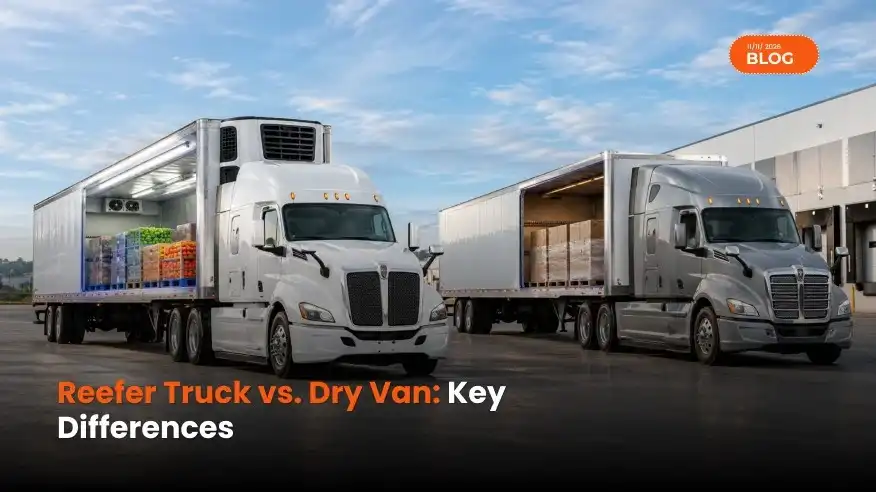
Two common options in the trucking industry are reefer trucks and dry vans. Both are used to transport commercial freight, but they serve different shipping requirements. A reefer truck is designed to carry temperature-sensitive products, while a dry van is generally used for goods that do not require active temperature control.
Understanding the differences between a reefer truck vs dry van can help shippers select appropriate equipment, manage transportation costs, and protect their cargo during transit.
In this guide, we explain how reefer trucks and dry vans work, what products they carry, their major differences, and how to choose the right option for your business.
A reefer truck is a commercial vehicle equipped with a refrigeration system that helps maintain specific temperature conditions inside its cargo area. The word "reefer" is short for refrigerated.
These trucks are commonly used to transport products that can be affected by excessive heat, freezing, or unsuitable temperature changes.
Unlike standard freight vehicles, reefer trucks have insulated cargo compartments and refrigeration units. These systems help maintain the required temperature throughout transportation.
Reefer trucks are commonly used for:
Fresh fruits and vegetables
Meat and poultry
Dairy products such as milk, cheese, and yogurt
Frozen food and seafood
Certain pharmaceutical products
Flowers and plants
Other temperature-sensitive products
The required temperature depends on the type of cargo. Fresh produce may need chilled conditions, while frozen products require much lower temperatures.
A reefer truck uses a refrigeration unit to control the temperature inside its cargo compartment.
The process generally involves the following steps:
Equipment preparation: The refrigeration unit and insulated cargo area are inspected before loading.
Temperature setting: The required temperature is established according to the product's handling instructions.
Pre-cooling: The equipment may be cooled before loading when the shipment requires it.
Cargo loading: Products are loaded with appropriate space for air circulation.
Temperature management: The refrigeration system operates during transit to help maintain the required conditions.
Delivery: Cargo is unloaded according to the receiver's handling requirements.
Reefer equipment is generally designed to maintain the product's required temperature rather than rapidly cool warm cargo. Proper product preparation and loading are therefore important.
A dry van is a standard enclosed freight trailer used to transport goods that do not require active temperature control.
It protects cargo from direct exposure to rain, wind, road debris, and other external conditions. However, a conventional dry van does not have a refrigeration system.
Dry vans are widely used in commercial freight transportation because they can accommodate many types of packaged and non-perishable products.
Common dry van shipments include:
Furniture and household goods
Electronics and appliances
Clothing and textiles
Packaged consumer products
Building materials
Paper products
Industrial supplies
Non-perishable food products
The cargo must be suitable for transportation without active temperature control. Some products may still require special packaging or environmental protection even when they do not need refrigeration.
Dry van transportation is generally straightforward.
The trailer is inspected to confirm that it is suitable for the cargo.
Products are packaged and prepared for shipping.
Cargo is loaded and secured to reduce movement during transit.
The trailer is transported to the destination.
Products are unloaded at the receiving location.
Since a dry van does not actively control temperature, shippers should consider seasonal weather and the product's sensitivity to heat or cold before choosing this equipment.
Although both vehicles are used for freight transportation, they differ in equipment, cargo suitability, operating requirements, and cost.
Here is a closer look at the main differences.
|
Comparison |
Reefer Truck |
Dry Van |
|
Temperature control |
Active refrigeration system |
No active refrigeration |
|
Trailer construction |
Insulated cargo compartment |
Standard enclosed trailer |
|
Main purpose |
Temperature-sensitive freight |
General freight |
|
Typical cargo |
Produce, dairy, meat, frozen food |
Furniture, electronics, packaged goods |
|
Equipment requirements |
Refrigeration unit and temperature management |
Standard trailer equipment |
|
Operating requirements |
Refrigeration operation and additional monitoring considerations |
General freight operations |
|
Shipping costs |
Often higher |
Often lower |
|
Cargo preparation |
Temperature and airflow requirements |
Packaging and load security |
|
Common applications |
Food distribution and pharmaceutical shipping |
Retail, manufacturing, and general distribution |
The most important difference is the ability to maintain controlled temperature conditions. A reefer truck is suitable when cargo requires refrigeration, while a dry van is appropriate for goods that can travel without active temperature control.
In many cases, reefer transportation costs more than dry van transportation. This is because refrigerated equipment requires additional components and operating resources.
However, the final freight rate depends on several factors.
Reefer trucks have refrigeration systems that require fuel or another power source, maintenance, and equipment inspections. These additional requirements can increase operating costs.
Dry vans do not need refrigeration equipment, which generally makes them less expensive to operate.
Refrigeration units consume energy while maintaining the required temperature. Depending on the equipment and operating conditions, this can contribute to higher transportation costs.
Longer routes can increase transportation expenses for both reefer and dry van shipments.
For reefer freight, extended transit times may also involve additional refrigeration operating requirements.
The availability of suitable reefer trailers can vary by location, season, and market demand. Limited availability may influence shipping rates.
Dry vans are commonly used across many freight markets, although their availability and pricing also change with demand.
Some refrigerated shipments need specific temperature settings, additional monitoring, or special handling procedures. These requirements may affect the overall quote.
Businesses should compare freight rates based on their actual shipment details rather than assuming one equipment type always has a fixed price advantage.
Reefer trucks offer several benefits for businesses that transport perishable and temperature-sensitive products.
The refrigeration system helps maintain the temperature range required for the cargo. This is important for products that may deteriorate when exposed to unsuitable conditions.
Food producers, grocery distributors, agricultural businesses, and other companies can use reefer transportation to move products between suppliers, warehouses, distribution centers, and retailers.
Refrigerated trucks make it possible to transport many temperature-sensitive products over longer routes when suitable equipment and handling arrangements are available.
Maintaining appropriate temperature conditions can reduce the risk of product deterioration during transit. However, product quality also depends on initial condition, packaging, loading, and handling.
Dry vans are a practical transportation option for a wide range of commercial shipments.
Businesses shipping packaged goods, furniture, electronics, and other non-temperature-sensitive products can use dry vans for many transportation needs.
The enclosed trailer helps protect products from rain, wind, dust, and road debris during transportation.
Without an active refrigeration unit, dry vans have fewer temperature-management requirements and generally lower equipment operating costs.
Dry van transportation is used by manufacturers, retailers, distributors, wholesalers, and businesses shipping general commercial goods.
A reefer truck is the better option when the product requires specific temperature conditions during transportation.
Consider reefer shipping when:
You are transporting fresh fruits and vegetables.
Your shipment contains frozen food or seafood.
You need to move meat, poultry, or dairy products.
Your cargo includes pharmaceutical products requiring temperature control.
Your products may be damaged by excessive heat or unsuitable cold conditions.
Your shipment instructions specify refrigerated transportation.
Before booking, confirm the product's temperature requirements and whether additional monitoring or handling procedures are necessary.
A dry van is generally suitable for cargo that does not require active refrigeration.
Consider dry van transportation when:
You are shipping furniture or household products.
Your cargo consists of packaged retail goods.
You are transporting electronics or appliances with suitable packaging.
Your shipment includes non-perishable products.
Your cargo can safely travel under normal enclosed-trailer conditions.
You want a standard transportation option for general freight.
Before selecting a dry van, check whether the product has any temperature or environmental restrictions that could make standard transportation unsuitable.
Selecting transportation equipment based only on freight price can lead to problems. Businesses should evaluate cargo requirements before booking a shipment.
A dry van does not provide active refrigeration. Using one for products that require controlled temperatures may expose cargo to unsuitable conditions.
Not all refrigerated products need the same temperature. Shippers should provide accurate instructions instead of using a general refrigeration setting.
Poor loading can restrict airflow in a reefer trailer. Even suitable equipment may struggle to maintain consistent conditions if cargo is not arranged correctly.
Weather can affect products transported in standard trailers. Businesses should consider seasonal temperatures and cargo sensitivity when selecting equipment.
The lowest transportation quote may not be the most suitable option. Equipment suitability, handling requirements, delivery schedule, and shipment risks should also be considered.
The right transportation option depends on your product, route, shipment size, and delivery requirements.
Before arranging freight, consider these questions:
Does the product require chilled or frozen conditions?
What temperature range must be maintained?
What are the shipment's weight and dimensions?
What is the pickup and delivery distance?
Are there specific loading or unloading instructions?
Does the shipment require temperature monitoring?
What is the expected delivery schedule?
Providing accurate information helps a logistics provider identify suitable equipment and discuss available transportation options.
For businesses shipping both general and temperature-sensitive products, having access to different freight transportation solutions can help simplify shipment planning.
Businesses need to select transportation equipment that matches their cargo requirements. Choosing between refrigerated and standard freight transportation is an important part of this process.
Empath Logistics offers logistics solutions for businesses arranging freight transportation. Shippers planning temperature-sensitive shipments should communicate their product type, required temperature range, shipment size, pickup location, and destination when discussing transportation requirements.
For businesses that need refrigerated freight solutions, explore Reefer Freight Services to learn more about temperature-controlled transportation options.
Understanding the difference between reefer trucks and dry vans can help businesses make more informed shipping decisions and plan their transportation requirements effectively.
The main difference is temperature control. A reefer truck has a refrigeration system designed to maintain specific temperature conditions, while a dry van is an enclosed trailer without active refrigeration.
Reefer transportation often costs more because refrigerated equipment requires additional operating resources, maintenance, and temperature management. Actual rates depend on shipment details, route, demand, and equipment availability.
Products commonly transported in reefer trucks include fresh produce, meat, poultry, dairy products, frozen food, seafood, flowers, and certain pharmaceutical products.
Yes. Dry vans can transport many packaged and non-perishable food products that do not require active temperature control. Products requiring refrigeration should use suitable temperature-controlled equipment.
They can maintain frozen conditions when the equipment is suitable and configured according to the cargo requirements. However, reefer trucks are also used for chilled products and other controlled temperature shipments.
Yes. Reefer trailers are designed with insulated cargo compartments to reduce heat transfer and help the refrigeration system maintain the required conditions.
Dry vans can be used in hot weather for cargo that does not require temperature control. However, businesses should consider whether their products can tolerate the expected conditions inside the trailer.
Manufacturing, retail, wholesale distribution, electronics, furniture, and construction-related businesses commonly use dry van transportation for suitable general freight.
A reefer trailer is used to transport temperature-sensitive products in an insulated cargo space equipped with a refrigeration unit. It is commonly used for food, agricultural products, and other refrigerated freight.
Start by checking the product's temperature requirements. If the cargo needs chilled, frozen, or controlled conditions, consider reefer transportation. If it can travel safely without active refrigeration, a dry van may be suitable.
Share:


Nov 03, 2026













‘0’ Comments
Leave A Comments